
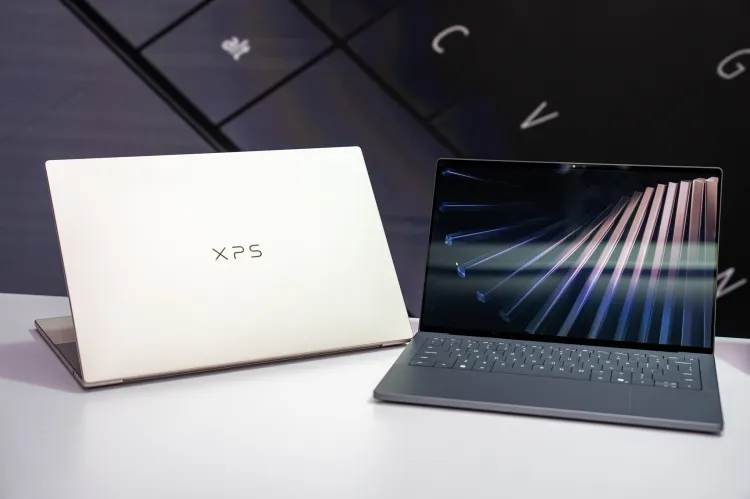
Dell XPS 14 and 16 Bring Back Premium Design with Smart Upgrades
The Dell XPS 14 and 16 are making a strong comeback—and they’re doing it with thoughtful refinements that address long-standing user complaints. After years of inconsistent updates and thermal compromises, Dell has clearly listened to feedback. As a result, these new models feel like a true revival of the XPS legacy rather than just another spec bump.
First, the physical function row is back. This may seem minor, but many professionals and power users missed dedicated F-keys for shortcuts in creative apps, coding, or system controls. In addition, the seamless haptic trackpad now features subtle etched lines along its edges. These provide tactile orientation without breaking the minimalist aesthetic—a smart compromise between form and function.
Moreover, both the Dell XPS 14 and 16 are astonishingly thin. While this enhances portability and visual elegance, it also raises valid concerns about thermal performance. Historically, ultra-thin XPS laptops have struggled under sustained workloads due to limited cooling headroom. Therefore, real-world testing will be crucial to see if Dell has engineered an effective solution this time around.
One of the most exciting upgrades is the inclusion of variable refresh rate (VRR) displays across all configurations. Specifically, the screens can dynamically shift from a buttery-smooth 120Hz during scrolling or video playback down to just 1Hz when showing static content like documents or emails. Consequently, this technology—borrowed from high-end smartphones—helps preserve battery life without sacrificing responsiveness. Impressively, even base models with IPS panels get this feature, while higher-end variants offer vibrant tandem OLED displays with exceptional brightness and contrast.
That said, there are trade-offs. Unlike earlier XPS generations, the Dell XPS 14 and 16 do not offer discrete GPU options. Instead, they rely entirely on integrated graphics from Intel’s latest processors. So while they’re ideal for productivity, media consumption, and light creative work, they won’t replace mobile workstations for heavy 3D rendering or gaming. Still, for most users, the balance of performance, efficiency, and design should be more than sufficient.
Furthermore, Dell has refreshed the lid branding with clean, modern logos—symbolic of the broader reset. The build quality remains premium, with machined aluminum chassis and near-borderless displays that continue the XPS tradition of minimalist sophistication. Ultimately, these machines signal Dell’s renewed commitment to the high-end ultrabook segment.
In summary, the Dell XPS 14 and 16 blend nostalgia with innovation. They bring back beloved features while introducing forward-looking tech like 1–120Hz adaptive displays. Although thermal performance and lack of dGPUs warrant caution, early impressions are highly promising. For professionals seeking a sleek, efficient, and beautifully crafted laptop, the XPS line is undeniably “back.”
Leave a Comment