
UK Supermarkets Launch ‘Jab-uary’ Food for Weight-Loss Drug Users
UK supermarkets are aggressively targeting a new consumer trend: shoppers using prescription weight-loss injections. Major retailers like Marks & Spencer, Morrisons, and Ocado are launching specialized food ranges for ‘Jab-uary’. This new term refers to the January period when people using drugs like Wegovy and Mounjaro seek suitable foods. These GLP-1 agonist medications suppress appetite, leading users to eat less. Consequently, supermarkets are introducing small-portion, high-protein, and nutrient-dense products to capture this growing market.
The shift is a direct response to observable changes in shopping behavior. Retail executives note that consumers on these weight-loss drugs are buying fewer indulgent items and seeking healthier, smaller options. Ocado has created a virtual “weight management” aisle with GLP-1-friendly products. Similarly, M&S sells a new “Nutrient Dense” range, while the Co-op promotes “mini meals”. This strategic pivot highlights how retailers are adapting to a significant pharmaceutical trend influencing food consumption.
Retailers Roll Out Targeted Product Ranges
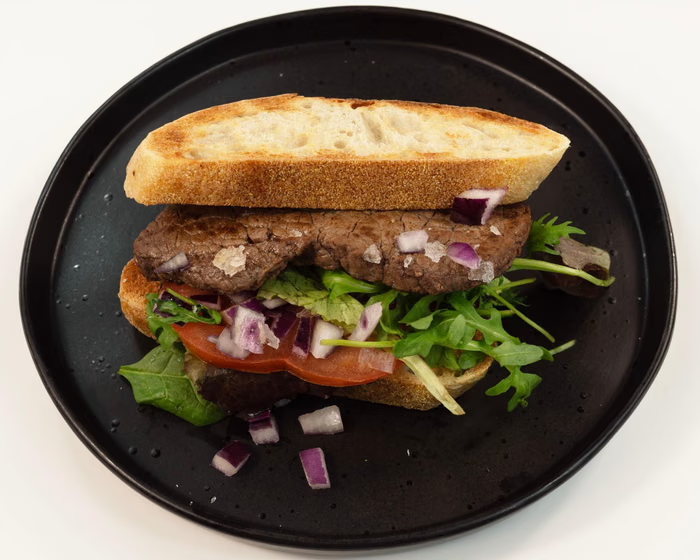
Each supermarket chain is taking a slightly different approach. Ocado’s curated selection includes tiny 100g steaks priced at £3.50 and premium supplements like AG1 powdered greens for £107. The online grocer reports strong demand for protein-rich staples, including chicken, cottage cheese, and health drinks. It also stocks the M&S “Nutrient Dense” line, which includes a £7 chicken satay ready meal and a £2 coconut water shot called H₅O, marketed for those reducing food intake.
Morrisons has launched an explicit “GLP-1 friendly” own-label ready meal range. These meals, such as chicken casserole, weigh only 280g but cost the same as larger dishes from other diet ranges. Analysts point out this creates a significant price-per-kilo premium. Sainsbury’s introduced its “Small but Mighty” 300g ready meals at £3 each. Interestingly, some brands like M&S and Co-op avoid directly mentioning weight-loss drugs on packaging, a marketing choice aimed at reducing potential stigma and broadening appeal.
Impact on Consumer Spending and Food Volumes
The widespread adoption of weight-loss drugs is beginning to impact grocery sales data. NielsenIQ figures show UK grocery sales value rose 2.5% in the four weeks to December 27. However, the actual volume of food and drink sold declined by 0.2%. This divergence suggests people are buying less food overall, potentially influenced by appetite-suppressing medications. A 2024 Cornell University study found households with a GLP-1 user reduced grocery spending by 5.3% within six months.
Certain categories are experiencing sharper declines. The study noted spending on savoury snacks like crisps fell 10.1%, while fast-food and coffee shop expenditure dropped 8%. In the UK, executives at Greggs commented that customers are seeking smaller portions and healthier options. This trend poses a challenge for food businesses reliant on volume sales, forcing them to innovate with premium-priced, smaller-portion products to maintain revenue.
Marketing Challenges and Consumer Perception
Supermarkets face a delicate marketing balance. They must cater to users of weight-loss drugs without alienating other shoppers or highlighting a potentially sensitive health choice. Analyst Jonny Forsyth of Mintel advises against explicitly grouping consumers into a “club” with stigma. He notes that M&S’s subtle “Nutrient Dense” branding is smarter marketing, as it appeals to a broader health-conscious audience beyond just drug users.
A key commercial challenge is justifying the price of smaller portions. Traditionally, “shrinkflation” – reducing pack size while maintaining price – angers consumers. Now, retailers must convince shoppers that small portions are a beneficial feature, not a disguised price hike. The success of these ranges depends on whether consumers see added value in specialized nutrition or prefer to simply eat less of their usual food. This is an unproven value proposition in a highly competitive market.
Future Outlook for the Food Retail Sector
The long-term influence of weight-loss drugs on food retail remains uncertain. With an estimated 6% of UK adults currently using GLP-1 medications, their impact is already significant. In the US, where adoption is near 20%, the effect is more pronounced. UK supermarkets are reacting quickly to avoid losing relevance. Tesco’s CEO Ken Murphy stated the company is watching the trend “very closely,” indicating further sector adaptation is likely.
For now, ‘Jab-uary’ represents a strategic experiment. Retailers are testing demand for premium small-portion meals. The trend amplifies existing shifts toward high-protein diets and health supplements. Whether these dedicated ranges become permanent fixtures or a passing fad depends on sustained drug adoption and consumer willingness to pay a premium for convenience and targeted nutrition. The UK’s cutthroat grocery market ensures that any successful innovation will be rapidly copied by competitors.
Leave a Comment